

Invisible braces for children
Start early – and your teeth will reward you with a smile. The sooner braces are started, the easier the orthodontic treatment usually is.
Treatment with invisible braces is a very popular, innovative and modern orthodontic method for children, too. Aligner treatment can help to correct misalignments at an early age and so avoid the effort of more extensive orthodontic treatment later on. On top of that, the transparent plastic aligners offer your child unrestricted comfort during treatment, combined with the highest standards of facial aesthetics.

Does my child need braces?
To prevent dysfunctions from causing misaligned teeth and/or jaws, treatment with invisible aligners can be used in young patients as early as the first phase of early treatment: the earlier a malocclusion is detected, the better the start of treatment can be timed. If in doubt, always get an expert opinion.
When does treatment begin?
When treatment begins depends on the patient’s individual situation. To determine the best time, we recommend a first check-up in the final year of kindergarten. Children who still have milk teeth are treated only to create the best possible conditions for the permanent teeth to come through. Correcting serious misalignments of individual teeth early on can help avoid surgery later. For example, a misalignment of the jaw caused by oral habits (thumb-sucking, dummies) should definitely be treated or corrected in childhood.
Checklist: when does treatment with invisible aligners make sense for children?
- to guide the growth of the facial and jaw bones
- to prevent incorrect tongue posture
- to create enough space for the permanent teeth that are still to come
- when dysfunctions need to be treated early

Possible malocclusions
The malocclusions listed below can occur in children on their own or in combination. If malocclusions are treated in good time, before growth is complete, later surgery can often be avoided. Treatment with invisible aligners has proven clinically effective for malocclusions and can be used for simple to complex corrections.
Spacing (gaps)
Missing teeth and gaps between the teeth often significantly affect not only appearance, but also the function of the teeth and the bite.
Possible consequences:
- functional problems (difficulty biting off food)
- receding gums
- gum pockets
- teeth drifting
Crossbite
With a crossbite, one or more upper back teeth bite on the inside of the lower back teeth. A crossbite can occur on one side or on both sides.
Possible consequences:
- jaw joint discomfort
- gum disease
- bone loss
- tooth wear
- asymmetrical face
Open bite
With an open bite, the front teeth of the upper and lower jaw do not touch each other, even when the teeth are closed together. An open bite can also occur at the sides. In extreme cases, only the rearmost molars touch when biting.
Possible consequences:
- missing and/or painful biting and chewing function
- jaw joint problems
- wear of the teeth
- craniomandibular dysfunction (CMD)
- negative effects on speech
- visible change in the shape of the face due to “lengthening” of the lower jaw
Underbite (forward position of the lower jaw)
An underbite can impair the normal function of the incisors or molars.
Possible consequences:
- tooth wear
- painful jaw and joint problems
- impaired facial aesthetics
How do invisible aligners work for children?
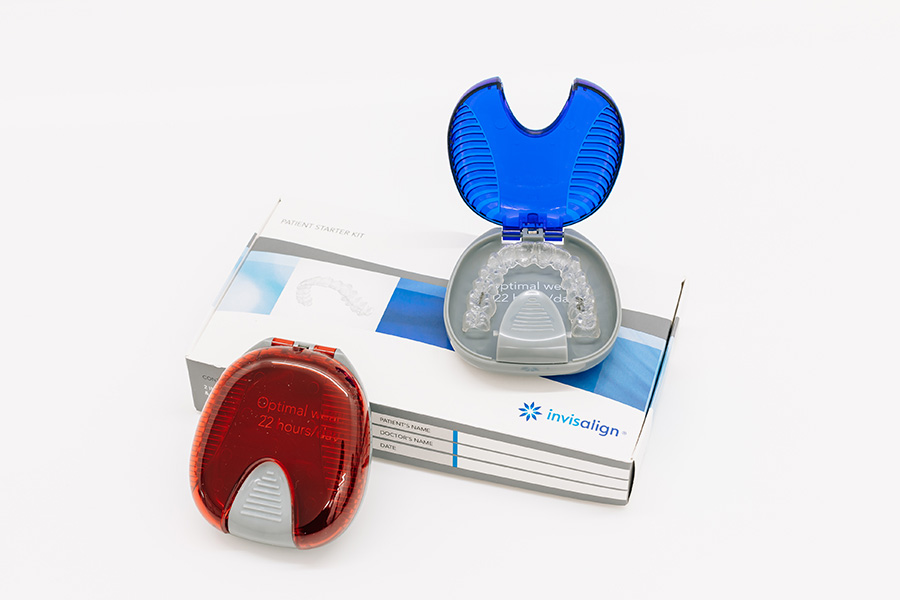
Treatment with invisible aligners offers many advantages that are tailored specifically to the orthodontic needs of growing children: the transparent aligners, made of lightweight plastic, are custom-fitted to the child’s teeth and create space for the teeth that are still coming through. The aligners encourage the jaws to develop further, which enlarges the oral cavity so that the tongue has more room and can take up its correct position. This helps to prevent tongue dysfunctions.
And the best part: the aligners are almost invisible, which can give children greater self-confidence and self-esteem during treatment. The aligners are removable, so your child can carry on living a completely normal life. During treatment, your child can keep up their normal oral hygiene and usual activities (such as eating, drinking, doing sport or playing a wind instrument).
Advantages of treatment with invisible aligners compared with conventional “bracket” treatment:
How long does treatment take?
In general, treatment in the primary and mixed dentition takes between 12 and 18 months.
Does the invisible aligner have to be worn every day?
Yes, absolutely. The removable braces must be worn consistently for 22 hours a day to achieve the desired result.
- greater self-confidence and self-esteem
- custom fit to the child’s teeth
- transparent and modern: almost invisible correction of the teeth
- no annoying wires or uncomfortable metal brackets that can cause irritation or allergies of the gums or oral cavity
- hardly any restrictions in everyday life
- optimal oral health, as the aligners are taken out for eating and oral hygiene
- hardly any pain or tension thanks to moderate pressure
- no effect on speech
- better periodontal conditions
- Greatly reduced risk of decalcification
- minimal to no emergencies, no injuries or inflammation of the mucous membranes
- less pain for the patient when changing aligners than when changing the wire on fixed braces
- no restrictions when doing sport or playing wind instruments
- fewer check-ups

Cost of braces for children
With monthly instalments, typical orthodontic treatment is affordable for all parents and an investment in your children’s future. The cost of orthodontic treatment depends on the patient’s individual needs and cannot be stated precisely, as complexity and effort vary. Most orthodontists generally follow the autonomous fee guidelines of the Vienna Dental Chamber. You’ll receive precise information at an initial consultation.
Before and after photos of braces in children
Philipp’s braces: Philipp had a deep bite and gaps. He was treated with invisible braces for 11 months.


